Wednesday, 23 September 2015

Jurassic World: A Monster with no Teeth


Let's go back in time. Not to the Jurassic era, but to fourteenth century England, to the man sometimes described as the father of the modern English language - Geoffrey Chaucer. In Chaucer's day, an author would often present his story as adapted from an original source, rather than as a work of his own imagination. Refering to an earlier work gave the work an authority in the readers minds.

Perhaps it's a stretch to compare fourteenth century narrative verse to movies in the twenty-first century (and in no way, er, pretentious). But it strikes me how many movies there are where we know the characters and story before we see the film. Even where a movie isn't based on a well-known brand or franchise, quite often the trailer will give the whole story away anyway. For instance, I've been told that the movie 'Pixels' is a case in point, and the trailer is basically a two minute version of the film.

Always good to force in a Chaucer reference

One might argue that this is not so much about refering to the authority of a previous film – rather, it's about films presenting us with something that's already familiar (and 'Pixels' is a film about 80s computer games coming alive and invading earth – talk about familiarity!). Most films nowadays are sequels, based on a toy brand, based on a book, or are in a particular genre defined by specific conventions. We go and see them knowing exactly what to expect.

But I'd argue for many mainstream films, authenticity is also an important factor. We want to know that what we're paying money to see is in some way properly endorsed. For instance, any movie based on an Alan Moore graphic novel is going to be an easier sell if it's endorsed by the author. And ditto the Harry Potter movies – fans want to know that the franchise accurately portrays the world and characters in J K Rowling's stories, and as she intended them to be.

Superhero films have a favourite device they use to subtly convey their authority to us, the audience, and that's the cameo role - for instance, Stan Lee having a walk-on part in Spiderman, or Wolverine's two-second appearance in a bar during X-Men First Class. For other films, think about the A-Team movie where two of the four original A-Team actors appears as other characters. Or Leonard Nimoy's appearances in the most recent Star Trek films. We, the audience, feel a little more secure in the knowledge that – although the film we're watching may be a stinker, at least it's a stinker endorsed by the creator /original actor /original character.

There's another device I've noticed which I'd imagine is a favourite of the Hollywood money-men. Where you've had a half-decent franchise and then a couple of bad sequels, you simply ignore the bad films, and set the rebooted sequel at a point after the good film(s). So, Superman Returns ignores the Christopher Reeve movies Superman 3 and Superman 4 (actually I rather liked number 3). And then there's Jurassic World. Apparently, they want us to ignore Jurassic Park: The Lost World, and Jurassic Park 3. Actually I'd rather turn that one on its head and ignore Jurassic World instead – but more on that shortly.

The excellent Christopher Reeve as Clark Kent, helping his alter ego dislodge a fishbone

Jurassic World is one of the highest grossing films of all time – so much so, that they've already commissioned a sequel. But I'd argue that Jurassic World isn't that strong a film and that its success is due nearly entirely to the affection we still have for the original films. This is only my assumption, but I'd guess that all of us movie-goers who saw the original films in the 1990s saw the trailer for Jurassic World, and were excited that a) the theme park is actually open to the public (great idea!), and b) the original characters aren't involved, so no tortuous back stories of existing characters need to be laboured over. The film-makers can just start again, taking the best bits of the original idea with a whole new set of characters.

And here's the first problem … sequels often strive for authenticity by slavishly copying or lifting elements from the original film(s) that aren't really needed. In Jurassic World, you have the billionaire theme park owner who is eccentric but with his heart in the right place (think Richard Attenborough's character from the original film). You have the warden character and the geeky guy in the control centre, both of whom are echoes of the Sam Neill and Jeff Goldblum characters in talking about respecting nature and not playing god. So, already the film-makers have restricted themselves without needing to.

The excellent Jeff Goldblum giving nerds a good name in the 1990s

I'd say the main problem is that this isn't really a dinosaur movie, it's a monster movie. We don't really get to see many different dinosaurs – the movie is only really interested in the T-Rex, the velociraptor, the sea dinosaur, the pterodactyl and the new 'Indominus Rex'. If we're talking of authenticity … I seem to remember that the first Jurassic Park was greeted quite favourably by the scientific community, as it was the first mainstream film to make the point that today's bird species are descended from dinosaurs, and it took the trouble to represent dinosaurs with (as far as we know) a degree of accuracy. By contrast Jurassic World isn't really interested in the range of dinosaurs or in an accurate depiction of them. I thought it was quite telling that, when the two boy heroes arrive at the dinosaur park, and open the windows of their room, the camera swoops out to a big crescendo of music that 'marvels' at the scene before us. The marvel isn't for any dinosaur, just the actual man-made theme park itself - and there's never any equivalent 'swell' of music that plays when we see the dinosaurs themselves.

It's as if the dinosaurs themselves are considered old hat, and we need something extra now to keep our interest as an audience. And oddly enough, this is precisely the gist of the plot of Jurassic World – visitor numbers are falling and they need a new attraction. It's not enough for us to enjoy the dinosaurs as dinosaurs. It seems that everyone has grown used to the Jurassic Park brand, so we need to be enthralled with something more monstrous.

Biggus dinosaurus - wait, that should be 'Indominus Rex'


So, what we end up with is less a dinosaur movie, more a reworking of other 'monster versus monster' movies, like Alien v Predator or Transformers where the 'monsters' fight each other rather than us, the humans. The problem is that this puts a lot of focus on getting those fight sequences right – the choreography and CGI become the stars, whereas fight sequences should always serve the interests of the story. To put it another way, the audience needs to be emotionally invested in the outcome of a fight – we need to care who wins and who loses. When you have two 'monsters' fighting and no main human characters involved, we don't care so much, even though one of those 'monsters' may be perceived as a 'goodie' and one as a 'baddie'. The outcome feels much the same whoever wins.

I'd argue it's not that dinosaurs are old hat – more that the film-makers of Jurassic World lost sight of what made the original Jurassic Park film(s) so good. In the first film, there's only a very brief scene where dinosaurs attack each other, and it's at the point one of the characters is about to be eaten by a velociraptor. If my memory serves me correctly, the character is 'rescued' in the nick of time by a T-Rex who fancies a velociraptor lunch. I seem to remember this bit working really well, as it's entirely unexpected - the audience isn't aware there's even a T-Rex around at that point to pounce on the unsuspecting other dinosaur. Even in the original film, therefore, dinosaur v dinosaur fights are very limited, and they serve a dramatic function – to rescue a main character in the nick of time. Dinosaur v dinosaur fights in themselves aren't actually all that interesting!

How do you work the cooker, again?

And the scenes that work best in Jurassic Park are where humans are the prey i.e. where the audience is emotionally invested in the outcome. For example, there's the famous scene where the T-Rex attacks the car with the kids in it (the humour of this being that the kids are told to stay in the car where it will be safest). Or another very effective scene is where the velociraptors are hunting the children in the kitchen with all those shiny metallic reflective surfaces. Ok, so there's an equivalent scene in Jurassic World where the kids are attacked in the safari pod which I think works quite well – it's quite funny that the dinosaur can't quite get its teeth gripping on the surface of the pod which is just too big for its jaws. But for me, the scene is still lacking something. The attack happens, and then the scene sort of fades out – there's the 'cop out' jump from a waterfall that brings that scene to a close (the kids jump but it's too high up for the dinosaur).

So, what's so good about those scenes I mentioned from Jurassic Park compared to Jurassic World? Obviously, Spielberg's direction has a lot to do with it. And part of that is the way he uses a convention that's a classic staple of horror and suspense movies – where a character perceived as being vulnerable or needing protection is put in a life-threatening situation.

In those two examples from Jurassic Park, it's the children who are the potential victims. At a basic level, watching any character deal with a life-threatening situation invokes our inbuilt 'fight or flight' instinct. However, by putting a child in danger we instinctively feel that the odds are in the aggressor's favour and this offends our natural sense of justice. It also increases the drama: the point is that a child character is no action hero – they have absolutely no additional qualification or expertise to deal with the situation.

Where children are involved, some very primitive emotional buttons are pressed in us and a basic human expectation is violated – the expectation that vulnerable people should be protected. I'd argue that having children deal with something they shouldn't have to deal with just 'feels' offensive to us as an audience. There's an underlying assumption here which is 'where the hell are the adults, and why aren't they looking after these kids?'

The ultimate dinosaur gobstopper

Ok, so perhaps this is more of a personal view (I have two young children myself!)
But there's an interesting point here. Jurassic Park is a film about survival – about the survival of a species, or more specifically the resurrection of an extinct species. So it's fitting the film should invoke our own instinct for survival /self-preservation.

For these scenes with children to work you need a final ingredient – which is the knowledge that the adults, while absent from the scene, aren't very far away. This might seem like a paradox, as you'd think there'd be more of a thrill if there are no adults around who could possibly rescue the children. But I'd argue the opposite - dramatically speaking, if no adults are around, there shouldn't really be any surprise when the kids are actually eaten up. Why wouldn't they be eaten up, when the odds are stacked so highly against them? And this may be a reason why, for me, the scene in Jurassic World where the kids in the safari pod are attacked doesn't quite have the impact of the equivalent scenes from Jurassic Park. The adults are on their way – sure – but they're not nearby in the way they are in Jurassic Park. In Jurassic Park it works the other way round - 'where the hell are the adults when we know they're close by?'

I think a fundamental reason for why Jurassic Park worked so well (and why Jurassic World doesn't) is that the film never forgets these animals are actually extinct. So, when dinosaurs and humans are pitted against each other, it's bringing together two species that were never meant to interact. We were never supposed to share the same timeline. It's a 'what if?' scenario. What if man and dinosaur had to co-exist or fight it out – who would win?

"First we take Manhattan ..."

The first film never forgets that these are caged animals waiting to overcome the restraints that are keeping them in captivity. The first film isn't explicit in this, but the logical extension of dinosaurs potentially overrunning the island is the threat that they might then overrun the mainland too. Extrapolate that further, and there's then the intriguing dramatic prospect that they could become the dominant species on earth again - millions of years after they became extinct. In that scenario it's then man that becomes the species under threat. So, actually, it feels like there's quite a lot at stake in the story.

The point is that Jurassic Park has a lot of fun drawing attention to the incongruity of having two species together that were never meant to be together – and it emphasises this by having the dinosaurs interact with man-made objects or environments, such as when the T-Rex attacks the kids in the car, or when the velociraptors hunt the children in the kitchen. There's a great bit towards the end of the film where, as the characters flee the visitor centre, the dinosaurs they've left behind are fighting each other, and the banner 'When Dinosaurs Ruled the Earth' flutters down on the carnage. I think that makes the point quite well – the wording of the banner smugly assumes the dinosaurs are shut up safely in their own cages as museum pieces, when they're busy causing mayhem and destruction.

As Indiana Jones would say: "It belongs in a museum"

You could argue there's an equivalent scene in Jurassic World where dinosaurs rampage around a man-made environment and it's where the pterodactyls are let loose over the theme park village and attack the crowds. But the problem is – that's all that happens. There's nothing more to it than that, possibly besides the bit where a low-flying pterodactyl with a human in its beak is then swallowed up by a leaping sea dinosaur.

Which brings us to the central idea of the original films, something lost in the reboot, which is … that Nature always finds a way. You can't expect to bring dinosaurs to life and control them. And this is, for me, a big problem with Jurassic World - all the dinosaurs are far too well-behaved! At one end of the scale, you have all the small innocuous dinosaurs that we briefly see in a petting zoo being patted by toddlers. And at the other end of the scale you have all the scary monsters behaving in contrived and predictable ways.

So, the velociraptors develop a bond with their owner, the T-Rex is released from its compound and duly understands it has to fight the Indomitus Rex dinosaur. Then in the final fight scene, all the dinosaurs instinctively understand they have to join forces to bring the new dinosaur down. In that scene you have a) the T-Rex, b) the velociraptor and c) the sea dinosaur all fighting for the common good! And in the very final scene, the T-Rex is stomping around on the helicopter pad back on the island looking wistfully out to sea looking like it wants to wave or give us a knowing wink or victory salute. I know this is a family film, but the bit where a dying dinosaur is comforted by the warden character and has a thankful expression on his face was pretty bad.

Pass me the sick bucket

What's wrong with having the dinosaurs behave like this? Well, it's attributing human characteristics and motivations to wild animals (well, ok, extinct wild animals). If I was being rude I'd say it's about Disney-fying these animals. It's neutering them. It's making them serve pre-determined interests. In effect, it's not letting them have a life of their own within the story. And it doesn't work, because the audience smell a mile away that it's derived.

And nowhere is this more evident than in the hypothesis that the hero is somehow the alpha velociraptor, and is able to influence the behaviour of the other velociraptors. Ok, I know this is just a film, but just think of the zookeepers in real life who develop a bond with the lions they look after, who are, all the same, mauled one day by those same lions, for no apparent reason.

I reckon that the makers of Jurassic World missed a trick here. If they had applied the fun and ruthlessness of the first two Jurassic Park films, rather than make this guy the hero, they should have killed him off – perhaps just at the point the audience feels that he's safe with his velociraptor 'pack'.

I have magic powers

Ok, so I've gone on long enough.

There's no space other than to just briefly mention in passing the skewed logic of a film where it's the hero who's to blame for the Indomitus Rex dinosaur being let loose in the first place, by falling for the ruse of thinking it's escaped. Or the fact the bad guy had a point – his idea is that the velociraptors could actually be used to kill the Indomitus Rex dinosaur, and this is, in fact, what happens and saves the day.

But just a few ideas I've had since watching Jurassic World that – to me at least – would just be a little more interesting. How about a situation like the Hunger Games, where people compete with the dinosaurs for money? It could be something very rich people pay for – to go on dinosaur hunts, with disastrous consequences. Or a black market type situation, where dinosaur baiting goes on 'underground'. Or even, to have dinosaurs doing what the original films threatened and actually taking over the mainland. Something, anything, except don't make Jurassic Park into an action hero film. In my view, they spliced together two movie DNAs that just don't work together. 

Sunday, 2 December 2012

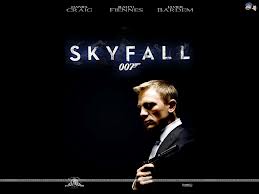
Skyfall Dissected


***SPOILER ALERT: ENTIRE PLOT AND DENOUEMENT REVEALED***

In my last blog, I wrote about the story ‘templates’ we carry inside us, that we instinctively refer to whenever we watch movies – by which I mean, we have specific expectations of what seems ‘right’ in a story. Whether a film meets these expectations, and – crucially – how it meets these expectations is fundamental to our enjoyment of the movie.

We may know nothing of the film we are about to watch, but even so, I’d argue that our expectations are determined within the first few scenes of the movie. We know very quickly whether we are watching - for instance - a superhero movie, a heist movie, a romance, a tragedy and so on, and we therefore know what to expect from it – if not, the details of exactly how it will develop or end.

However, the James Bond franchise is fairly unique in that we have very specific ideas not just about what should happen but also how it will happen.
We know that there will be an opening action sequence that will try to outdo previous Bond movies, we know that the story will take us to a number of exotic locations, we know there will be two Bond girls, and we know there will be a villain who is intent on world domination who Bond has to stop at all costs.
The elements of a Bond film are so firmly established that they have been parodied many times over, not just in the original 1960s Casino Royale movie, but also in the Austin Powers films – and in numerous Rob Brydon impressions (“We’re not so different, you and I, Mr Bond”)

It’s inevitable that, as more and more Bond films have got made, the newer films have even come to reference the older films – whether intentionally or not. You can’t have a Bond film with skiing without invoking memories of On Her Majesty's Secret Service. Any rooftop chase, any traintop fight, any fight on top of an aircraft, any car, motorbike or speedboat chase will invoke memories of the appropriate movie (at least for James Bond nuts like myself!). Even plotlines are being re-used, and as innovative as Skyfall is, you could argue it’s a repeat of the Goldeneye story – former British Secret Service Agent turns rogue, and plots against his former employers.

What I really liked about Skyfall is the way it embraces those traditions, storylines and plot elements and gives some emotional depth and resonance to them. I was interested to hear Sam Mendes talk about this on BBC radio’s Front Row programme, and explain how the writing team set out first and foremost to tell an engaging story, and only later did they add the ingredients we might expect from a conventional Bond film. In other words, the traditional Bond elements were made to serve the story, and not the other way round.

The R&D department in happier times


One simple example is the role that gadgetry plays (or doesn’t play) in the film. Whereas in previous films Bond is given unnecessarily sophisticated devices, in this film, much is made of the fact he is given just a gun and a tracking radio. Indeed, there are two exchanges between Bond and the villain where they both take it in turns to gloat over their use of something so simple as a radio device. Having something so simple as a radio device is seen as ‘old school’ which is a key theme in the film. Bond uses a cut throat razor to shave, and just in case the audience have missed the significance of this, the writers have Eve commenting on this being something very traditional. Later in the movie, Bond drives ‘M’ in the Aston Martin from Thunderball, and then the denouement of the film itself takes place at Bond’s ancestral home, where Bond has only one shooting rifle, and homemade weapons at his disposal.  There’s clearly an agenda going on here – the film-makers are making a not so subtle point about the Bond films not needing to lean on technology and gimmickry for their dramatic impact (even though one could argue that previous Bond films have often done the opposite). They’re recognizing that what Bond does best is real-life stunts and live action chases. And of course, Bond kills Bardem’s villain not with a gadget dart fired from under his wrist, or with an exploding pen, but with a simple knife in the back.

I liked the way that, even when the makers of Skyfall do the standard Bond stuff, they manage to do something a little different with them. Mendes opens the film with a long shot of Bond where Bond walks into focus – which I see as a riff on the famous gun barrel opening of the traditional Bond films (the traditional Bond opening sequence in fact occurs at the end of Skyfall). Then there are the one-liners that Daniel Craig delivers in as humourless a way as he can possibly contrive. His comment ‘A waste of good whiskey’ when the first Bond girl is killed in the William Tell scene is really laced with heavy irony, and is not meant to invite audience laughter. When Craig walks through the train carriage having leapt off the digger he makes a very subtle adjustment of his cuffs – the kind of gesture that occurred frequently in the Brosnan films, but is somehow less cartoonish as acted by Craig. Again, a very small detail, but I also enjoyed Craig’s reactions in fighting in the casino circled by giant lizards. Twice he gestures the lizards to the bad guy he’s fighting, in a way that draws his combatant’s attention to their mutual danger, and (I thought) to the absurdity of the situation. In previous films, Bond (and the audience) wouldn’t have batted an eyelid at something so unrealistic. Craig’s reaction here again serves to make his Bond much more rooted in the ‘real’ world.

Skyfall’s villain does indeed live in a secret base on an exotic island location, but this base is simply a deserted town – but if anything, this creates a bigger dramatic impact for being more realistic and not being, for instance, a rocket complex hidden inside a volcano. The sobriety of this particular Bond is underlined by his lack of a triumphant one-liner when he kills Bardem’s villain.  His comment ‘Last rat standing’ seems to acknowledge that this is in some ways a pyrrhic victory – which indeed it turns out to be when M dies a few minutes later.

 The Bond villain parody - in happier times


Another feature I particularly enjoyed was the economy of the writing. Every scene is used to further the purposes of the plot. When Bond is taking his marksman tests, he can’t fire straight because of the shrapnel in his shoulder. He gauges out the shrapnel in his shoulder with a knife (thus showing this is a tougher Bond than previous incarnations), and the shrapnel is then analysed by the forensics team, which enables them to identify Bond’s assailant from the opening sequence. The last known sighting of this guy was in Asia, so Bond now jets off to Asia. In other words, the writers don’t just send Bond to exotic locations for no reason – they take care to establish a chain of logic that shows why he’s going there.

The economy of the writing can be seen even in the small details – in one scene, Bond is exercising doing pull-ups on a bar, after which he collapses through lack of fitness. In a later scene, Bond has to rely on his upper body strength to hold on to the bar under the elevator.  Without the earlier scene, the audience would assume this is easy for Bond. Instead, the earlier scene provides us with the information that Bond isn’t fully fit, and this therefore introduces an element of risk to the elevator scene as to whether he’ll be able to hold on (this being Bond, we obviously know the answer to that!)
  
Okay, so I’ve talked a lot about the way Skyfall takes the ingredients of a standard Bond film and does something slightly different with them – but I’d argue that this is only part of the reason why the film engages our interest.

I’d say that interest in the film is created by a number of key narrative strands: Bond’s rehabilitation and his attempts to prove he’s not a spent force; M’s attempts to survive the political fallout from the crisis engulfing MI6 and – in the last act of the film – the attempts on her life; and Mallory’s ascendancy to the head of MI6, and the audience’s changing attitudes towards this character. In other words, the film is held together by its character development.

At the beginning of the action, Bond is not just unfit and unproven - he’s assumed to be dead, and it takes the entire film for him to prove he’s got what it takes to continue in the Secret Service - both to his employers, and perhaps to himself.
He spends much of the earlier part of the film unshaven and failing fitness tests – and until the final act of the film, as he admits himself, it’s been the Bardem character who’s been taking the initiative. If we’re talking story templates, this is one of the most powerful there is: where an untried and untested character initially ‘fails’ but eventually rises above the odds to claim victory eg Rocky, The Matrix, 8 Mile and so on.

I’d say that the best way of understanding Skyfall is as a transitional Bond film. Essentially it’s a two hour swansong for Judi Dench as M. I say this, because – to some extent – Bond’s supposed death at the beginning of the film foreshadows M’s death at the end, and prepares us for it (late in the film, Bond’s underwater fight in the icy loch is in some ways a reprisal and reminder of the earlier underwater drowning scene).
So, the film is bookended by two key deaths: Bond’s supposed death, and M’s real death at the end. They’ve written the script so that, in dramatic terms at least, it’s seen as necessary that M does die as she is accountable for the deaths of various British agents and has made some morally dubious decisions. In the opening sequence, Bond wants to help a fellow agent who is about to die, but M orders him not to. Again, it’s M’s decision that Eve shoots without a clear line of sight with disastrous consequences for Bond. M chooses her own interests (the interests of Queen and Country) above an individual agent’s life. For the first half of the film, she’s under siege politically for her handling of the crisis, and it’s only when she’s allowed to speak during the hearing scene (just after the film’s halfway point) that events start turning in her favour.

And it’s at the hearing that we first see Mallory in a more sympathetic light, first, when he interrupts the Chair so that M can put her own views across, and then when he risks his life in the gun fight that ensues – thus proving he’s not the deskbound pen-pusher that Bond suspects him to be.  Mallory then walks in on Q as he’s laying a false trail for Bardem – and tacitly sanctions support for the unofficial operation that Bond is leading. In other words, at the same time the film is giving Judi Dench a good send-off, it’s also busily building up Ralph Fiennes as the next M.

I say that Skyfall can be understood as a transitional Bond film, but I wonder to what extent Daniel Craig’s reign as Bond can be seen in the same way. We are already three films into his tenure –even so, I think it’s telling that right at the end of this film he’s being asked (by the new M) whether he’s ready to start work. It’s also taken three films to establish the new Q (who hadn’t featured in the previous two films), the new M, and the new Miss Moneypenny. It’ll be interesting to see whether they continue with this approach in the next Bond film, or whether Craig Bond film 4 will be the equivalent of the first film with a new Bond.

Lazenby: the ultimate transitional Bond. But what a great movie OHMSS was!


It’s also interesting to note that technically Bond is only a few missions into his career, and yet a big theme of the film – as noted above – was about being too old for the job. I read this as a reference not to the character’s actual age or stage in his career, but as a reference to the Bond franchise. But still, it makes the chronology of Bond quite intriguing and contradictory – in exactly what mission did Daniel Craig’s Bond drive a 1960s Aston Martin? A question for another day and another blog!

Sunday, 4 November 2012

The Stories we carry within us: Why there's no such thing as a 'new Story'


It may be stating the blindingly obvious, but I’ve recently been realizing that many Hollywood mainstream films have what I would call a ‘self-evident’ plot structure. What I mean is, when you’re watching a film and you know roughly how it’s going to develop, and even how it’s going to end. Which is rather odd, when you think about it. Why would we watch something when we know (roughly) how it’s going to turn out?

When we watch Batman, Spiderman, Rocky – or even the King’s Speech for that matter – we know that the story goes something like this: First Part: establish character or character’s special power > Second Part: character goes through some kind of crisis > Third Part: Denouement: character is pitted against his nemesis, boxing opponent or stutter, and wins.

If you think about it, it’s odd we should all want to see stories enacted for us, where we know roughly (if not exactly) what’s going to happen. Why would we do this? Again, it may be to state the blindingly obvious, but I think the answer lies in the fact that although we might know what’s going to happen, we don’t know how it will happen.  I think much of our viewing pleasure relies on us having some idea of what kind of story we’re watching and therefore how it might develop. We go into the cinema with a set of story ‘templates’ in our mind which we automatically – and without thinking about – refer to in watching a film. For the Lord of the Rings we might access that part of our story knowledge which covers ‘The Quest’. For the Kings Speech, the story that gets invoked is probably a ‘Battling against Adversity’.

The analogy that I think helps here is to think about how poetry works. There’s (more often than not) a rhythm underlying a poem that we understand as a metre, and the interest of the poem is created by the ways in which the poem either does and does not conform to that underlying beat.

So, while we’re watching or reading The Lord of the Rings we have various in-built assumptions: that good will triumph, that the heroes will prevail – either by being victorious and staying alive, or by giving their life in a cause that’s ultimately successful. I think our expectations give us a structure which helps us mediate our emotional responses. So, we ‘get through’ the times of crisis in the film – as it were – by retaining the knowledge that it will all work out in the end. Such a structure is important, because otherwise stories would be reduced to a series of random events. Without an idea of what should and should not happen, why should we be surprised if it all goes wrong?

I’d say that, in particular, Hollywood mainstream films and kids’ films wear their plot structure very close to the surface. Within the first few minutes, the audience instinctively knows the general thrust of the film, who the bad guy is, and what the main character’s ‘mission’ is. It’s clear when we watch ‘Happy Feet’ that this will be a story about a character being different from everyone else, and finding acceptance – even adulation – within his community. Within the first ten minutes of ‘Finding Nemo’, it’s clear this is a film about reuniting Nemo with his parents – and we instinctively know that this reunion will take the rest of the film to accomplish.  When you think about it, it’s amazing how strongly rooted these templates are inside us. If ‘Finding Nemo’ ended with Nemo dying, or Nemo’s Dad dying, we, as an audience would feel cheated – we’d feel that in some way, this didn’t work. By all means, have one of the characters appear to be dead; by all means, have one of the characters believe that the other character is dead (in fact, one or the other, or even both scenarios are generally essential in these types of stories); but don’t actually have the character die. 

At the very least, the film-makers would have to find some kind of meaning in Nemo’s death – in other words, it would have to be written as a Tragedy, and – once again – we’d actually be aware of this fact right from the beginning of the film. Even if you didn’t know Hamlet as the most famous play in the English language, you would know instinctively that this is a story with an unhappy ending, a story about various wrongs committed before the play began, and which will now be put right at the cost of the hero’s life.

This all goes back to the ‘contract’ set up between the story-teller and the audience which is in place from the moment the film /story /play begins.  When someone starts a story with ‘Once upon a time’ (or its equivalent), our expectation is that this is a story that will be worth listening to.  Our response if a story does not live up to our expectations is not to lose faith in stories or films, but to identify the flaw – quite rightly - within the film itself. We might not even know exactly why it doesn’t work – we might blame it on the actor, on the special effects, on certain parts of the story – but we just know instinctively that the film doesn’t work. 

Conversely, there’s a particular kind of satisfaction we get when we come out of a cinema having seen a really good film – one that renews our faith in film-making, or in humankind or even – by extension – ourselves. I’m not banging a drum for these particular films, but I was struck by the fact that the Kings Speech reportedly had audiences spontaneously applaud at the end. And I remember the same happening when the Full Monty was first released (at least, it happened at the showing I was at). The audience’s experience here is about the film hitting the spot and needing to express that recognition collectively – despite the fact that the actors, director and film-makers are probably many miles away at that precise moment, and can't hear us.

I believe that we all carry around with us a set of story templates which are deep rooted in our emotional lives. These aren’t individual to us, but collective (although we may carry individual ‘variations’ or predilections for certain kinds of stories). The ‘against all odds’ story, the couple get together after  misunderstandings story – and so on. When we are satisfied by a story it isn’t just that the story is gripping or compelling on its own terms; it’s also in the way this individual story gives voice to the deeper story we carry within us. 

To put it another way, the need for stories starts when we are very young, and never leaves us. When we are children we want to hear the same stories repeated over and over again - and perhaps our adult experience of stories is simply a variation on this.

Saturday, 18 August 2012

In Praise of Waffle: the danger of editing your stories out of existence


***No plots or denouements were harmed or mistreated in any way in the making of this blog entry (for once)***

Well, I had to, didn't I?


Recently, I’ve been recalling a quote made by Andrew Motion about his time as a Booker Prize judge, where he explained that many of the novels he read for the prize ‘needed a good edit’.  His emphasis was more on the care and support an author’s novel gets (or doesn’t get) from the Publisher: ‘Not nearly enough novels get the editing they need’.


But it made me think about a view that’s prevalent nowadays amongst creative writing circles, that good writing is about expressing something succinctly, with no extraneous word, and every word that’s used contributing towards the whole. In short, that more stories nowadays could ‘do with a good edit’. The style en vogue in creative writing, I would say, is very much the style we might associate with American writers like Raymond Carver. Carver was known for following a particular writing process where he would go over his story draft again and again and pare down the words to the bare minimum.

Six Books in need of a good edit

You can see why a poet like Andrew Motion would make this comment: poetry is all about paying attention to each individual word, and its place within the poem, and using each word to its maximum effect: being alive to the different meanings that might be given by its particular location within a poem. And this isn’t to criticize Raymond Carver either, as I’m a big fan of his work. But at the same time, it strikes me that this is only one view of what good writing should be about. You have only to go back to the great 19th Century novels, to find a rather different model of writing.

And here comes the History bit....
Dickens is hardly known for his brevity of expression. Indeed sometimes he uses ten words where one will do. And yet interest in him is still very much alive, with 2012 seeing many events that celebrate the bicentenary of his birth.

Herman Melville, one of my favourite writers, was hardly a succinct writer either. Indeed, many of the first readers of Moby Dick would probably have appreciated it had that work been given a thorough edit. A key feature of the novel is that the story is interspersed with chapters that interrupt the main narrative and provide a learned disquisition on different kinds of whales, which – one might say - effectively slows down the ‘action’ of the novel.

But the whole point about Moby Dick is that it’s rough around the edges. It’s not supposed to be clean, and neat. It’s about the smell of sea and rope.
In a letter written after he’d finished the novel, he famously confided: ‘I have written a wicked book, and feel spotless as the lamb’. The novel is often seen as being about the search for meaning, or as in some way enacting that quest (and the attendant perils) and as such it’s entirely appropriate that it ended up being like the behemoth that is the subject of the story.

If floundering in your argument, invoke the Bard ...

"Words, words, words"


Perhaps the idea of giving something ‘a good edit’ is the kind of comment that’s most frequently made by one contemporary about another, rather than by posterity (posterity often seems much kinder about these things)

Ben Jonson famously wrote down this anecdote about Shakespeare in the papers that were found after his death:

I remember, the players have often mentioned it 
as an honour to Shakespeare, that in his writing 
(whatsoever he penned) he never blotted out a line. 
My answer hath been, would he had blotted a thousand.

So, Shakespeare, one of the greats of all time, was judged by Jonson as lacking the ability to edit his own work – and as being someone who was too easily satisfied with the standard of the plays he wrote.

It’s a feature of Shakespeare we often forget that his plays actually require editing every time they’re staged. It’s very unusual to see a performance of the complete text: scenes, characters or lines are cut as a matter of course. Witness how unusual it was when Kenneth Branagh released his film of Hamlet which dramatizes the complete script.

Being a photo of a moustache in need of a good edit

We simply accept the fact that the plays work without certain lines, scenes and characters. And yet we don’t, for a moment, hold this against Shakespeare and condemn him as a writer who was unable to polish his own work. Indeed, modern audiences happily do without the long-winded wordplay or comic larking about that the Elizabethans so loved. In a recent documentary on Hamlet presented by David Tennant, one Academic even suggested that the 'bad quarto' of Hamlet (the supposedly unreliable text of Hamlet that didn't reflect Shakespeare's intentions) has a lot going for it in being shorter and snappier than the canonical version.

Time for an analogy...
I would argue that the editing process isn’t just about paring down, removing and deleting. It’s not about cutting the pieces off the rock until we get to the irreducible diamond. For me, it's not about finding the tiny precious gem in the hunk of raw material, and sometimes it's better to leave some bits of the raw material behind.

Blogger in search of a diamond


So what am I saying? That verbosity is good? No. But I think one person's view of what's extraneous isn't necessarily the same as another. In his introduction to Lord of the Rings, JRR Tolkien explained that he sometimes received letters where readers complained about particular characters, or scenes and he was amused that these characters or scenes were often ones that other readers declared were their favourite. 

So, to use the diamond analogy again, what one reader may dismiss as the extraneous material, other readers value as the diamond. One could take it further, and suggest that the artist or creator of the work themselves aren't always able to discern the gem from the stone. Or rather, that in applying certain subjective (and quite harsh) criterion, the creator can often end up rejecting something that still has meaning and value for others.

To use an example from popular culture, there's an interesting interview with Christopher Lee where he talks about the making of The Wicker Man, and bemoans the fact that the finished film bore little resemblance to the much better film they had scripted. Generations of movie-goers still value the film that they ended up making - indeed it's often ranked as one of the best films of its kind.

At least the Wicker Man was actually released - even if not in the form that was originally intended. Think of Kafka who was ambivalent towards his work to the extent that he didn't even want it to see the light of day, and asked Max Brod to burn his unpublished work after his death (although Brod made it clear that he no intention of doing so).

Rather than think of editing a work as being about cutting something to the bone, I'd like to suggest another model might be equally effective - that of jazz improvision. Not every note of a solo is needed, not every note is possibly as effective as it could be, there are musical phrases that could equally well be replaced by others. There may be times when the musician loses the attention of the listener momentarily (or for longer). The key thing is not that the musician comes up with something perfect and flawless, but that what they create is something that excites our interest most of the time, that sustains our interest most of the time and (if that interest is lost) that recovers it quickly. 

If we're reading a novel and don't like the direction the plot has taken or think a particular scenario is unrealistic, or we don't believe in the action of a character, our interest is still recoverable provided the rest of the novel engages us. But of course, if there are too many unrealistic scenarios or situations that don't ring true, our interest will be permanently compromised.


Couldn't resist this one.......


Sunday, 13 May 2012

Susan Hill's 'I'm the King of the Castle'


***SPOILER ALERT: ENTIRE PLOT AND DENOUEMENT REVEALED***

It’s fairly easy to identify what makes a film work, particularly when that film is a mainstream Hollywood movie. In this blog, I’ve talked a bit about superhero movies and how these tend to use a limited number of ingredients. I think it’s not for nothing that a whole language of scriptwriting has developed which refers to some stock devices in films, such as the need for a ‘Third Act’.

Of course, there are many novels that mimic the structure of a mainstream film – some of these one feels that the author has even had half an eye to being adapted for the screen.

But I’d argue that novels are (generally) more sophisticated and complex than mainstream films, and that anyone wanting to unpick a novel, and ask ‘how do novels work’ is in for a tougher challenge than just putting the latest Marvel comics movie under the microscope.

My own opinion is that books are more effective because they stimulate the reader’s imagination in a way that doesn’t happen on film where everything is presented in ready-made visual form to the audience. Indeed, the most effective films are those which still leave something to the audience’s imagination. Think of any effective horror or suspense film.

In novels, the structure is often not so heavily dependent on external events /plot as it is on the exploration or development of character. As an extreme, think of ‘To the Lighthouse’ where the novel focuses exclusively on the interiority of its characters. Virginia Woolf reverses the standard approach by spending most of the novel describing the ebb and flow of her characters’ thoughts during a Summer’s day. Events which might normally serve as the main subject of a novel (a war, the death of one of the main characters) she relegates to a middle section of about five pages.

All of which is meant as a caveat to the following analysis. I can’t really do justice to Susan Hill’s ‘I’m the King of the Castle’, as it’s a complex and subtle work, which – like all good novels- resists attempts to reduce it to its constituent parts. So I’ll try not to take it apart, but rather to suggest a few ways it’s put together.

For those who haven’t read it, it’s about two boys thrown together by circumstances, and the bullying that takes place between them, with Hooper the tormentor and Kingshaw the victim. The novel begins with Kingshaw coming to stay in Hooper’s house accompanied by his mother, who has applied for the job of housekeeper, and the novel ends when the persecution has driven Kingshaw to such extremes that he takes his own life. So there’s a natural span to the action of novel.

The novel is given structure by the rhythms and dynamics of the relationship between the two boys as they get to know each other, or rather as they metaphorically circle each other, and as Hooper finds ever more ingenious ways of getting under Kingshaw’s skin.  The action is mostly confined to the house, which lends the novel a certain claustrophobia  (emphasis is given to the house at the beginning of the novel because we learn that it represents something quite ambiguous for Mr Hooper in its connection with his own father). But the action is also punctuated by various events such as Kingshaw’s aborted attempt to run away, and by a day out to the ruins of a castle and then, near the end of the novel, by a visit to the circus.

The novel charts how Kingshaw’s metaphorical escape routes are gradually but systematically closed off – either intentionally (as in Hooper’s case) or otherwise. Kingshaw can’t run away without Hooper following. To have his own privacy he has to continually evade Hooper, but knowing that Hooper will eventually discover which room he’s locked himself into – and Hooper frequently reminds Kingshaw that he is a guest (or worse) in his house. Kingshaw feels that Hooper will always win, whatever the situation.

What starts as a fixed period of time before Kingshaw can go back to school and be free of Hooper changes into a more dreadful prospect – the decision to send Kingshaw to the same school as Hooper, where Hooper can marshall other bullies to prey on Kingshaw. At the same time, the marriage between their respective single parents changes Kingshaw’s stay to a permanent one, and therefore removes any hope of a change in his situation.

The reader feels it wouldn’t be quite so bad were Kingshaw actually listened to by either of the parents. But the adults either willfully misunderstand him, or lack perception to interpret what is going on around them – dismissing his complaints as just a ‘boy thing’. For a short time in the novel, Kingshaw finds a genuine escape and enjoyment in his friendship with Fielding because this is something that he can keep to himself, only for Kingshaw’s Mum to unintentionally intrude on that as well.

One of Kingshaw’s final acts in the novel is to go into Hooper’s bedroom, tear down the battle plans Hooper is so fond of, take them outside, and tear them up into tiny pieces and burn them. It’s less a decision to act or fight back as it is the ultimate admission of powerlessness in that it expresses a terrible frustration that has no other outlet or hope for relief. Indeed, Hill’s decision to have Kingshaw burn the scraps of paper is effective in that it doubles as an act of provocation to Hooper, and also as an act of concealment – ie burning away the evidence of what he’s done. Kingshaw’s decision to drown himself in the wood is moving – and perhaps inevitable – because the pool of water is the one place he has recently managed to find any sense of freedom.

The tension created in the book is all the more effective because of the moments of reprieve that Hill allows her character. There are moments where Kingshaw thinks things might after all be ok (incidentally mirroring his mother’s expressed hope that they will all be a family, and that ‘things will be ok’). He proves himself resourceful and a clear thinker in the storm that reduces Hooper to a quivering wreck. At the time there seems every prospect that the role reversal in the wood where Kingshaw takes charge will defuse the situation back at home. The fact it does no such thing somehow makes the return to the status quo all the more chilling.

Kingshaw also finds temporary relief in his friendship with Fielding which is formed during the time Hooper spends in hospital. Kingshaw’s initial suspicion of Fielding shows how far Hooper has got under his skin in encouraging a distrust of others. There’s a scene where Kingshaw explains his problems to his new friend, and you really feel that this human contact might be a watershed moment and that Fielding might be able to suggest ways of dealing with Hooper that will defuse the situation. But ultimately Hooper’s influence pollutes this friendship as well.

The relationship between Hooper and Kingshaw has a certain symmetry about it which I think acts as a kind of glue for the novel. It’s not just that both boys have lost a parent, and are grieving about this or are both prey to related fears and nightmares. For instance, in the wood Hooper hits his head and becomes unconscious at risk of drowning in the water nearby, in way that prefigures Kingshaw’s own actual drowning at the end of the book. Also the two near-fatal /fatal events in the novel (Hooper’s fall from the masonry, and Kingshaw’s drowning) although caused indirectly by the other boy, are both self-inflicted.

As an aside, the fall from the castle wall is particularly impressive in that Kingshaw has the thought that he could just push Hooper off and kill him, and is sorely tempted to do so but doesn’t, only for Hooper to misinterpret Kingshaw’s innocent arm movement as a sinister one, resulting in him losing balance and falling anyway. There’s something here that reminds me of Dostoevsky – where a character thinks of a murderous act which he could quite easily have gone ahead with, decides not to, only for the results of that act to occur anyway, and in such a way as to make him look guilty after all. As another aside, it’s satisfying that Hill has this key scene take place at a literal castle, in reference to the title.

And finally there’s an interesting contrast in the reactions of first Kingshaw to Hooper’s supposed death, and then at the end of the book, Hooper’s reaction to Kingshaw’s actual drowning. Kingshaw has the perfectly normal human response of utter devastation at thinking he may have caused his tormentor’s death. By contrast Hooper’s first (and only stated) reaction at the end of the book is to feel pride that it is actually him who has brought about his victim’s death.

This is the same author who brought us ‘The Woman in Black’. So if you’re interested in hearing about her ideas on ghost stories, I”d recommend a Christmas ‘Start the Week’ programme on Radio 4 where she discusses this with Claire Tomalin (among others).
At the time of writing the programme can be downloaded at:

Saturday, 5 May 2012

Ridley Scott's 'Alien': It’s all about the Cat

*** Warning: Contains Spoilers for Alien, and the sequel Aliens***


Well, actually, 'Alien' is all about the suspense. We’ll come to the cat later.

Much of the appeal of the first film comes from not even knowing what the ‘Alien’ of the title refers to – although it’s easy to lose sight of that fact with the endless sequels and spin-offs that have been spawned over the years, and have made us very familiar with the look (and modus operandi) of the ‘Alien’.

So it takes half the film before we actually catch a glimpse of the Alien, and understand that it’s intending to destroy the whole crew.... a lesson that James Cameron’s Aliens sequel employs to similar effect when he delays the first big on-screen encounter with the aliens until halfway through the film

The opening sequence of 'Alien' makes clear that a danger or threat exists, but without defining the precise nature of that threat. In the first minute or so the camera pans through a seemingly empty (and enormous) spacecraft, and the unsettling music makes it clear that something isn’t quite right. Blinking monitors reflect on the visors of two space suit helmets (is someone inside that suit, we wonder, and if so, why are they not moving – are they dead?), and the ship appears to be running itself seemingly without anyone being on board - a bit like the Marie Celeste. First-time viewers are also presumably wondering whether this is, in fact, the ‘after’ of the story, and whether the rest of the story will be told in flashback.

To boldly go ...
For the first half of the film, I think interest is created partly by the understanding that ‘something is going to happen’ - this film is called ‘Alien’ after all! But also, quite simply, by the re-imagining of space travel. This isn’t pioneer space exploration as we’ve experienced in Star Trek; the crew of the Nostromo are simply doing a job moving cargo through space. The characters on board express no wonder at the technology around them, or at being out in space, or at coming out of a hibernated sleep. I like the way almost every early scene has someone clutching a coffee mug, or eating, or smoking which gives an informality to these scenes. Perhaps the fact these characters are entirely at ease with their space surroundings and each other makes us feel the opposite, and that this is all rather “alien” to us. Even the names of the characters are odd and therefore suggestively futuristic – Ripley, Ash, Kane.

I liked the way we experience the characters as a team at the beginning – to the extent that it’s difficult to keep track of all the different people and what their role is on the ship. It’s certainly not clear that any one of these people is destined to survive and become the hero /heroine of a 4-film franchise!

I always knew Bilbo was an android....


Of course, there are some pointers to the fact that Ripley is likely to survive – or indeed, that she has earned the right to survive. It’s clear that at crucial stages of the drama, Ripley stands firm and makes the correct call when others senior to her do not, and also that she thinks for herself. It’s Ripley who translates the distress signal, and realizes it is, in fact, a warning. It’s Ripley alone who refuses to let the alien on board – a decision that Ash overrides with calamitous results. It’s Ripley who decides they should leave the ship and blow it up, and it’s Ripley who keeps her head, and tries to stop the self-destruct when she realizes the alien is blocking her route to the escape shuttle. But, crucial to maintaining suspense, Ripley’s inevitable survival is only clear in retrospect. Once it’s clear the alien will pick them off one by one, it’s not certain who or how many of the crew will survive.

Which brings us to the cat, Jonesy.


New Alien franchise: Alien versus Jonesy the cat??


The cat performs a number of roles in the story. He’s used as a diversion in an early ‘false alarm’ scene. Ripley and Parker detect motion on their gizmo, only to find it’s Jonesy. When the cat runs off, Brett follows it, thereby separating himself from the group – and inevitably it’s at this point he’s killed by the alien. When Jonesy hisses, initially we think he’s reacting to Brett, when of course he’s reacting to the alien behind him. So, the cat acts as a cipher to the killing.

Jonesy is also used as a plot device at the denouement – Ripley risks her life by going back to fetch him, then runs into the ‘alien’, drops the cat cage, and runs back to try and stop the self-destruct countdown.

But I’d say the cat performs a role that’s central to the emotional journey of the film. Imagine the very last scene, when Ripley has destroyed the alien, but without the cat being there. The emphasis of the scene would then be on the fact all of Ripley’s colleagues and friends are dead, and she is left alone – which might feel like a kind of defeat. But the way the it's actually written, Ripley isn’t alone – she has the cat who, like herself, has survived against the odds. I think of the cat as being a bit like the crew’s mascot, and that therefore for the cat to survive means that Ripley has truly defeated the alien because something of the crew has survived.

And the writers have clearly invested some importance in the animal surviving. When Ripley drops the cat cage and runs off, there’s a great camera shot of the alien turning to the cat and baring its teeth in a grin. The implication is that it’s about to kill the cat too, and so it’s quite satisfying from a plot structure point of view when it turns out that this is not the case, and the animal has, surprisingly, survived.

Not a cat


Enough about the cat!
Ok – so the film might well have worked without having a cat in it. In fact, when I re-watched Alien recently, I realised I’d completely forgotten there’d even been one in it!

But I’d argue that the character of ‘Newt’ in Aliens performs a similar role – much of the drama and emotional impetus is derived from Ripley’s protection and defence of this 11-year old girl (a situation made all the more emotive due to the fact Ripley’s own 11-year old daughter is dead). Again, imagine 'Aliens' without the girl’s character. It would become a much flatter story, and reduce the action to something more like ‘Return of the Living Dead’ where characters are picked off one by one. If you were being cynical, you might suggest these ‘cypher’ characters /cats are introduced simply to simulate an emotional depth that would otherwise be lacking.

But I think the reason why Alien works better than its sequels is partly because there is in fact more emotional depth to the story. Ripley is a character who thinks first about others. She acts in the crew’s interest by challenging Ash’s conclusions about the distress signal; she goes back to rescue the cat at the end; and when she assumes command of the ship, her priority is to make sure the alien is killed and the remaining crew members escape.

Which makes it all the more disappointing that they ‘break contract’ with the audience at the beginning of Alien 3, by killing the entire crew who survived Aliens, just to extend the action to another sequel.

Wednesday, 29 February 2012

The Killing: Getting away with Murder?


***Spoiler alert: plot and identity of murderer revealed***

The annual Danish 'Who can look the moodiest' competition 


The Killing is such a good piece of TV, if you haven’t watched it already, I would really recommend you read no further.

Twenty hour-long episodes is a long time to keep interest going. So, how do the writers keep us watching and tuning in for next time (or reaching for the next DVD in the box set)?

One obvious technique they use is that they have multiple prime suspects. Well, you don’t need me to tell you that if you’ve watched it! We lose count of the number of times the murderer’s identity seems clear and the crime solved, only for Lund to work out some new angle which casts her previous assumptions into doubt.

We suspect first Nanna's teacher, then Troels Hartman, then the other politician, Jens, then Vagn, then the taxi driver character, and finally Vagn again. And those are just the main suspects.

Crucially both the teacher and Troels remain prime suspects much longer than they need because both have alibis they are unwilling to reveal – indeed, it seems they would prefer to be suspected of the murder, or even arrested, to protect their secret. Subsequently it’s revealed that the teacher was helping someone escape from an arranged marriage, and that Troels had actually attempted suicide on the night in question, and that both men respectively wanted to keep these facts a secret. Neither of these alibis fully account for their reluctance to reveal all. In real life, of course, each suspect would give their alibis much earlier – but then this is just a story, and there would be much less dramatic interest in everyone being up front and honest.

The writers create further dramatic interest with the situations that develop around the respective prime suspects. For instance, Lund being alone with Troels and looking through his diary when he might come back into the room at any second.  Or by having Troels arrested right in the middle of an all-important Council meeting. Or by having the teacher go in to school and being spat at by his pupils. Or when he’s beaten up by the father, egged on by Vagn when we know he’s innocent.

In which I make a spurious reference to a much loved 1980s icon ..... 
The writing is very clever in that it never definitively commits to anything. The writers get away with having their cake and eating it. Someone you felt was beyond suspicion could become the prime suspect; someone who had previously been cleared could be back in the frame. Watching the series reminded me of a Rubiks cube. I felt the writers could take the story this way, or they could just as easily take it that way. The different combinations and sequences of combinations were almost limitless. Is the Police chief hiding something? Is Lund taken off the case because there is some wider conspiracy at work? Is Troels’s girlfriend Rie playing him?

Because a Rubiks cube would have been just too obvious...


No character ever seems to be able to definitively rule themselves out, even though you'd imagine this would be perfectly straightforward for them to do. For instance, Jens does a very good job of behaving like a serial killer when he ties Lund up, and plays games with her – he even ties Lund up using the same material that the murderer used on the victim. Is this really how someone would react when their involvement in a hit and run has been discovered? Just before he’s killed he says something helpfully ambiguous – not ‘I didn’t kill her’ but something like ‘I could never have killed her’.


'What's my motivation again?'
And that’s a key point.At least three of the characters die before the police can get the complete story. Jens is killed before he can be brought in for questionning, the taxi driver character hangs himself, and Vagn is killed after confessing to Theis.  I would argue that it is necessary for the writers to kill off these characters before they’re able to give the police the full story – because this smooths over inconsistencies and implausibility about the details of the story which would come to light in any lengthy confession to the Police.

My reading of the murder is that it was carried out on the spur of the moment for racist reasons. But throughout the series, we were led to believe the murderer was a serial killer. So, we have a serial killer murdering on the spur of the moment acting from a racist motivation – when none of his previous crimes had anything whatsoever to do with race. Hmm… doesn’t quite add up to me.

I would argue that The Killing is best appreciated as a game or as a diversion rather than as a representation of ‘reality’. It’s a game where there are certain rules. The main rule is that the murderer should be someone obvious but not someone we’ve seriously suspected – a difficult combination to pull off. In fact they do this very cleverly with Vagn. The scene where he’s arrested for the murder is directed to make it seem like the police have got the wrong man, as the taxi driver character is busy hiding in the corner looking guilty.  When Vagn is released, the writers create more of a smokescreen by having Pernille and Theis effectively throw him out the house. This engages our sympathies for Vagn in a way that stops us thinking any more about his potential guilt. There’s no better way of diverting the viewer’s suspicions than by having a character arrested, particularly when the arrest happens a few episodes before the end. Besides, this is Vagn! Dopey, reliable, simple Vagn!

Spurious reference to Bill Hicks coming up...


A final thought - it's just a ride..... 
I would argue that The Killing is very good at creating tension and keeping us guessing about what's really going on.  But the feverish excitement generated is never fully matched – can never possibly be matched – by the eventual revelation of the killer’s identity. Then again, I think The Killing should be watched to enjoy the ride, rather than to get to the destination.